
Nicholas Kadunce

Projects

Tools and systems I've built to drive operational excellence.

Operations Daily Dashboard

Interactive daily operations email with real-time KPIs, downtime analysis, quality metrics, and action tracking—sent automatically each morning.

VBA Outlook Excel Automation
Explore sections
Interactive Feature

In the live email, clicking the Maintenance chart opens an interactive drilldown view. Try it below:

Explore Maintenance Interactive Drilldown Explore Interactive Drilldown

Daily Operations Dashboard

Real-time visibility into production, safety, quality, and maintenance metrics—built for morning stand-ups and executive review.
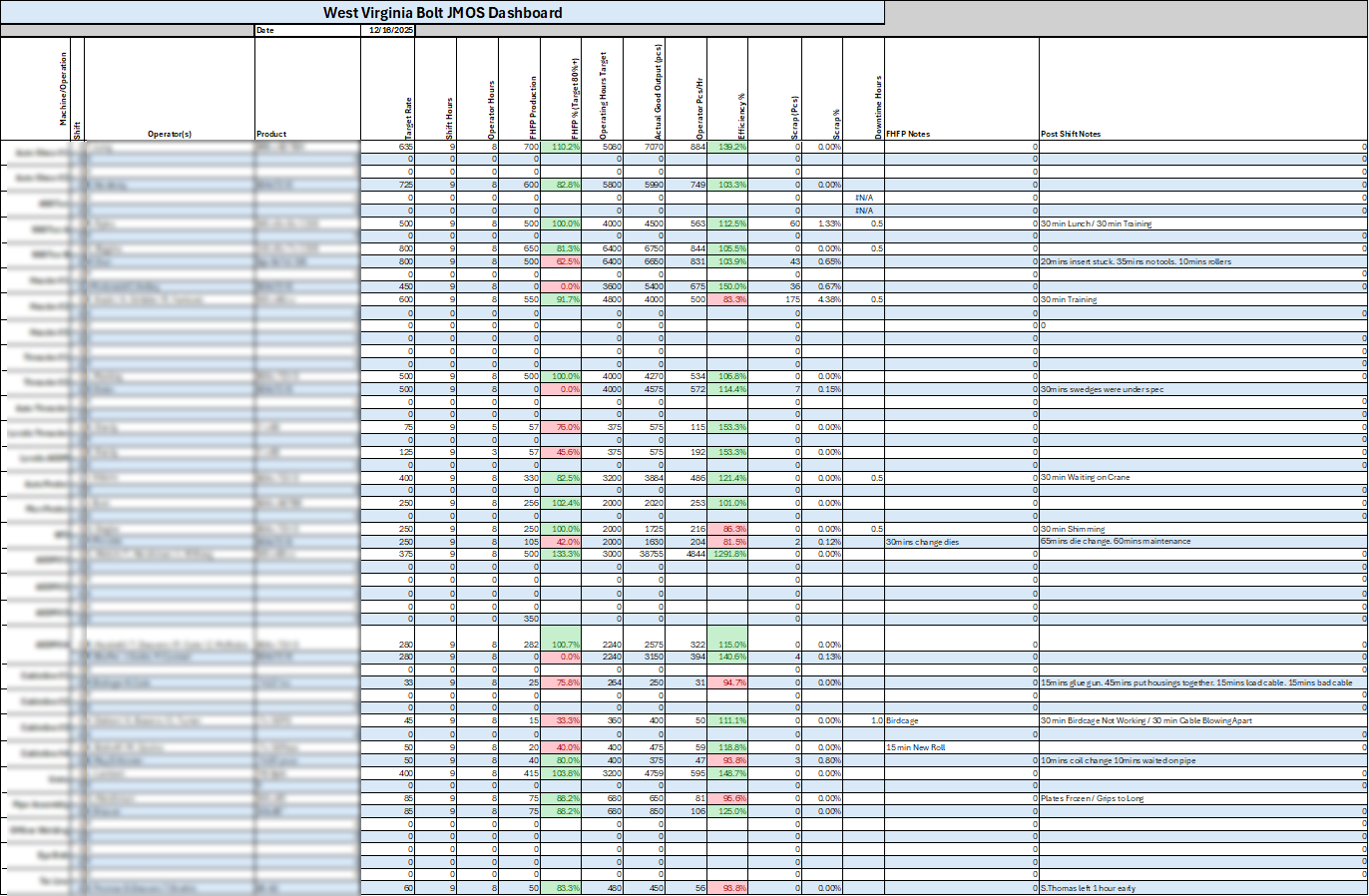
JMOS Daily Operations Dashboard showing production metrics by machine and operator

Downtime Analysis

Hour-by-hour Pareto analysis of production losses, categorized by root cause for targeted improvement.
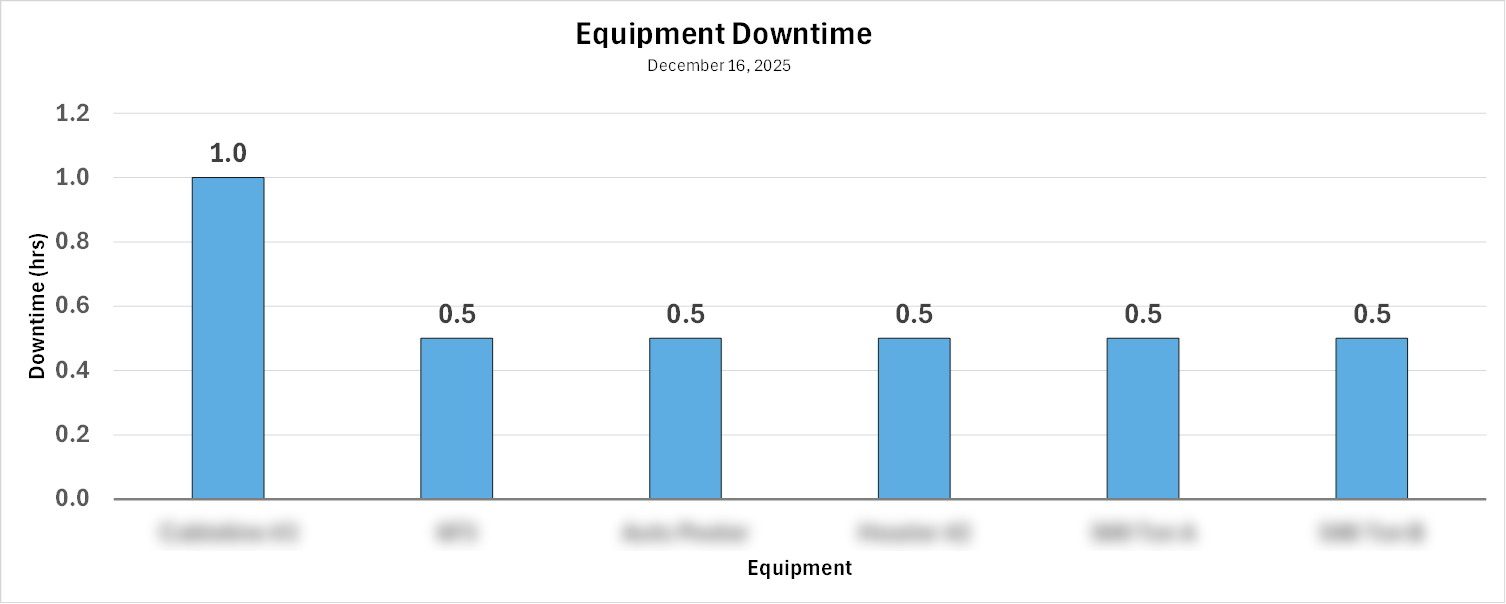
Equipment downtime bar chart showing hours by equipment

Quality Metrics

Defect rates, rework tracking, and quality trends across production lines.
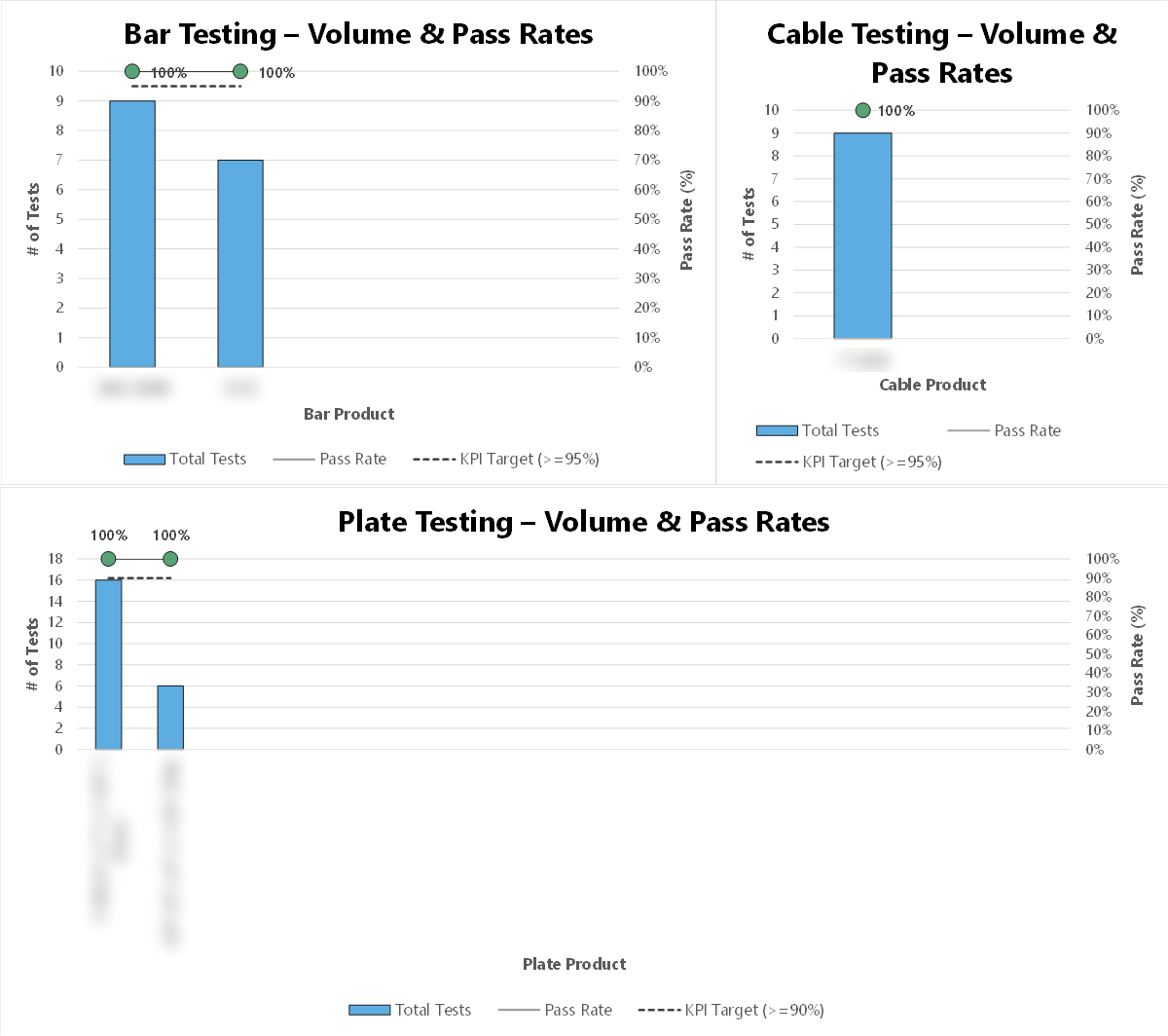
Quality testing volume and pass rates by product type

Safety Dashboard

Incident tracking, near-miss reports, and safety observation trends.
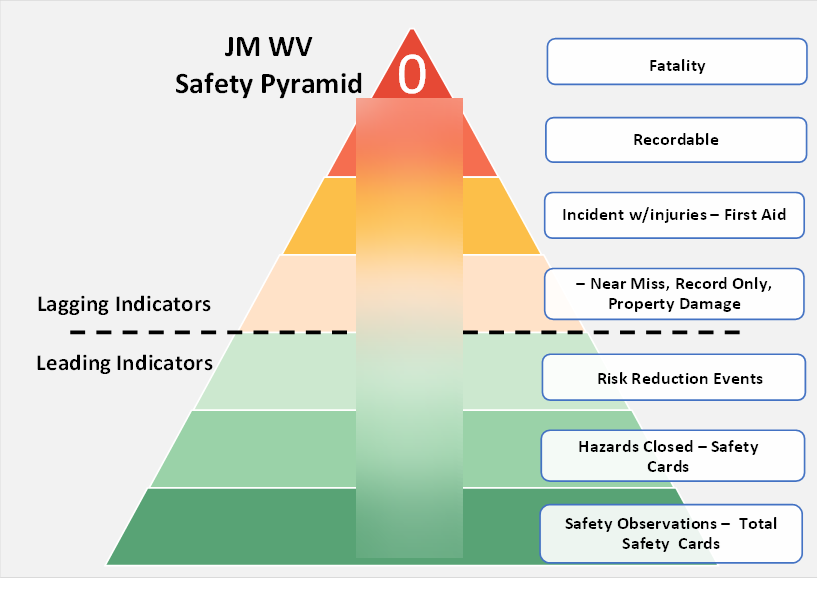
Safety pyramid showing leading and lagging indicators

Maintenance Tracker

Work order status, PM completion rates, and equipment reliability metrics.
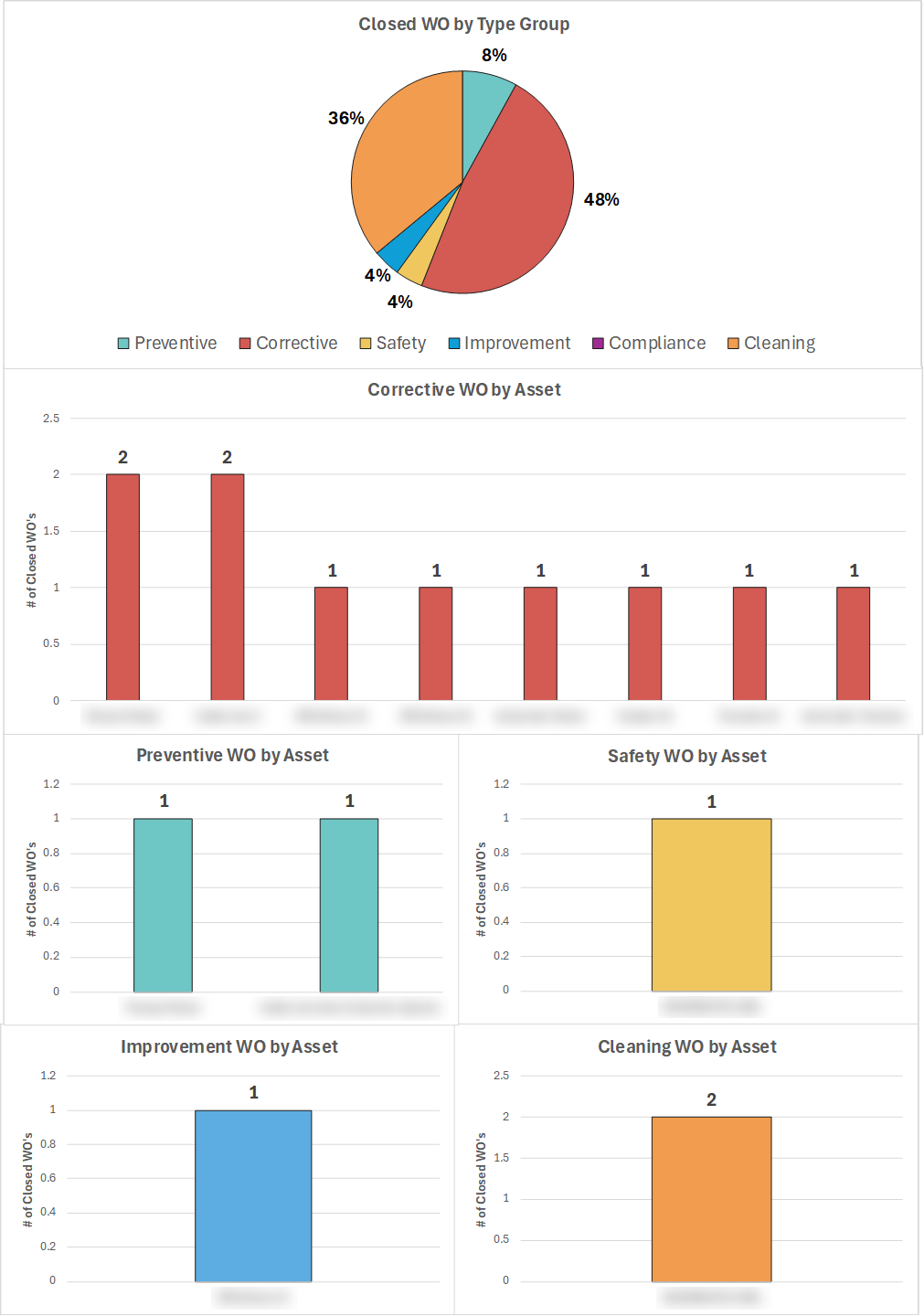
Maintenance work orders by type and asset

Financial Forecaster

Forecasting tool integrating market data with production capacity for optimized scheduling.
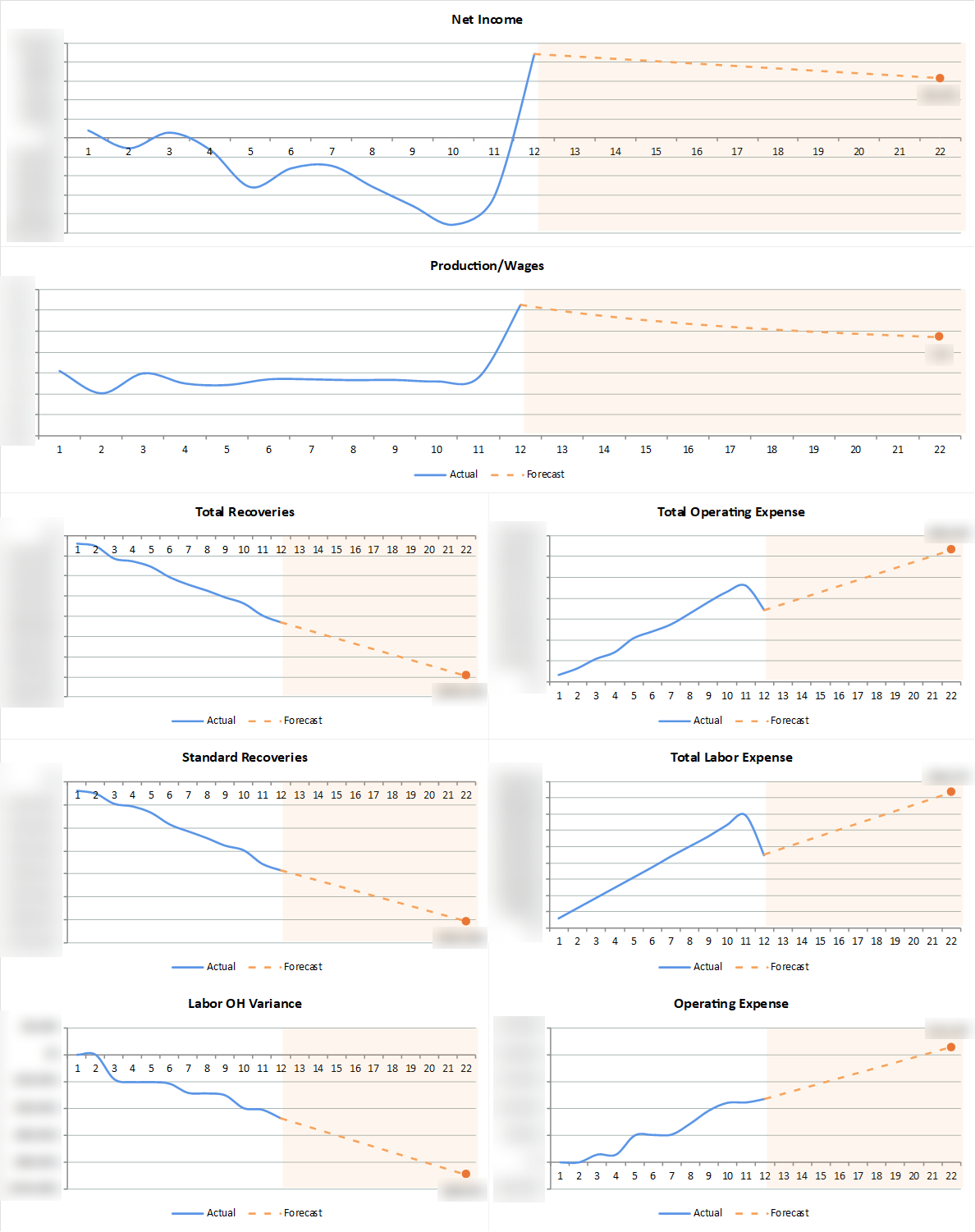
Keystone forecasting charts showing actual vs forecast trends

Action Items

Tracked issues and follow-up items with ownership and due dates.
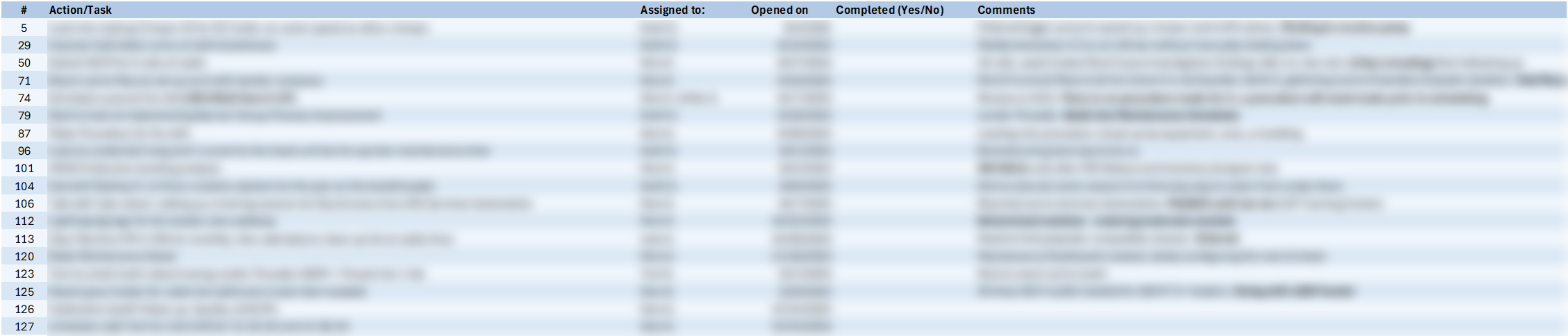
Action items tracker with assignments and status

This interactive demo mirrors the automated daily email sent to plant leadership each morning.

Hour-by-Hour Production Tracking

Shop-floor performance tracking system replacing next-day reporting with hourly visibility—automating calculations, graphs, KPIs, OEE, and employee performance scoring.

VBA Excel OEE Analytics

Hour-by-Hour Production Tracking

Hour-by-Hour Production Tracking is a shop-floor performance tracking system designed to replace next-day (24‑hour delayed) production and scrap reporting with hourly visibility—without the capital investment required for PLC-driven automation. Team leads record hourly output by station and quickly classify scrap and downtime using standardized defect and downtime codes. Once entered, the tool automates all downstream reporting, including calculations, graphs, hour-by-hour performance boards, gap analysis, KPIs, OEE, and raw material scrap tracking, and integrates with the quality dashboard to strengthen defect monitoring and trend identification. The system was later expanded to compile daily performance and scrap trends by employee and generate "Employee Scores" to support recognition of top performers, targeted training, and consistent performance management.

0:00 / 0:00

Financial Forecaster

Data-driven forecasting tool using 3-month rolling averages to generate daily financial projections, strengthening performance and improving oversight efficiency.

VBA Excel Forecasting Analytics

Financial Forecaster

Financial Forecaster is a data-driven forecasting tool that uses 3-month rolling averages to generate daily financial projections from the most recent actuals. It streamlines consolidation and analysis to strengthen financial performance and improve the efficiency of financial oversight, with planned enhancements including seasonal weighting and advanced statistical methods as more historical data is collected.

0:00 / 0:00

Maintenance Dashboard

Asset-level analytics tracking work order volume and labor hours by maintenance type, optimizing technician utilization and reducing non-value-added effort.

VBA Excel CMMS Analytics

Maintenance Dashboard

Maintenance Dashboard is an asset-level analytics dashboard that tracks work order (WO) volume and labor hours by maintenance type, providing clear visibility into which assets generate the most activity and consume the most time. It helps identify equipment and maintenance trends to improve asset availability, optimize technician utilization, and reduce non–value-added maintenance effort.
0:00 / 0:00

Six Sigma Green Belt Project

Applied DMAIC methodology to drive measurable process improvements in manufacturing operations, with documented results from Define through Control phases.

Six Sigma DMAIC Process Improvement Analytics

Six Sigma Green Belt Project

This Six Sigma Green Belt project followed the DMAIC (Define, Measure, Analyze, Improve, Control) methodology to identify root causes and implement sustainable process improvements. Click each phase below to view the presentation materials.

1
Define Phase

Project charter, problem statement, scope definition, and stakeholder analysis.

View Project Plan
2
Measure & Analyze

Data collection, baseline metrics, root cause analysis, and statistical validation.

View Midterm Presentation
3
Improve & Control

Solution implementation, results validation, control plans, and sustainability measures.

View Final Presentation

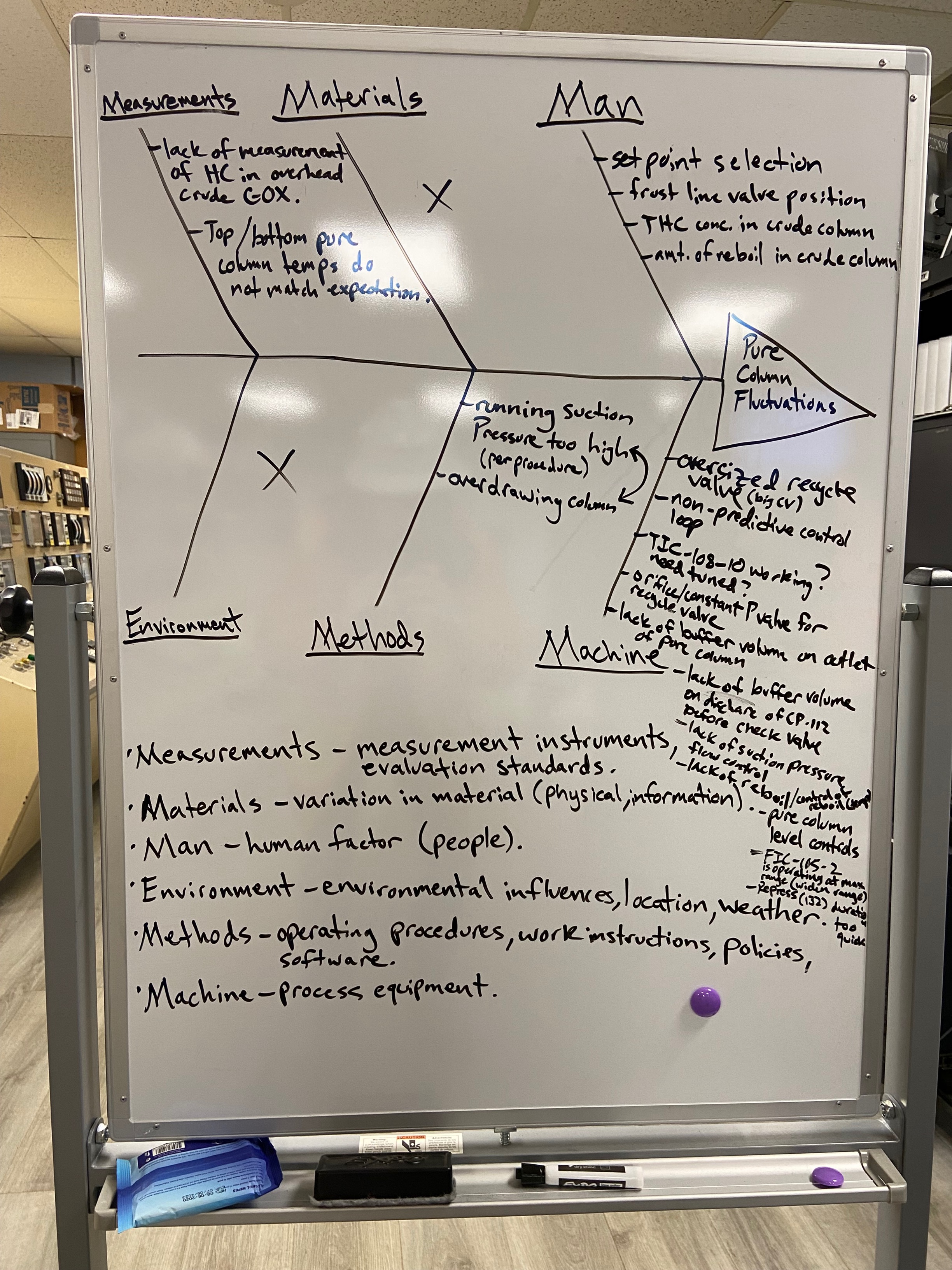
Root Cause Analysis (Fishbone / Ishikawa)

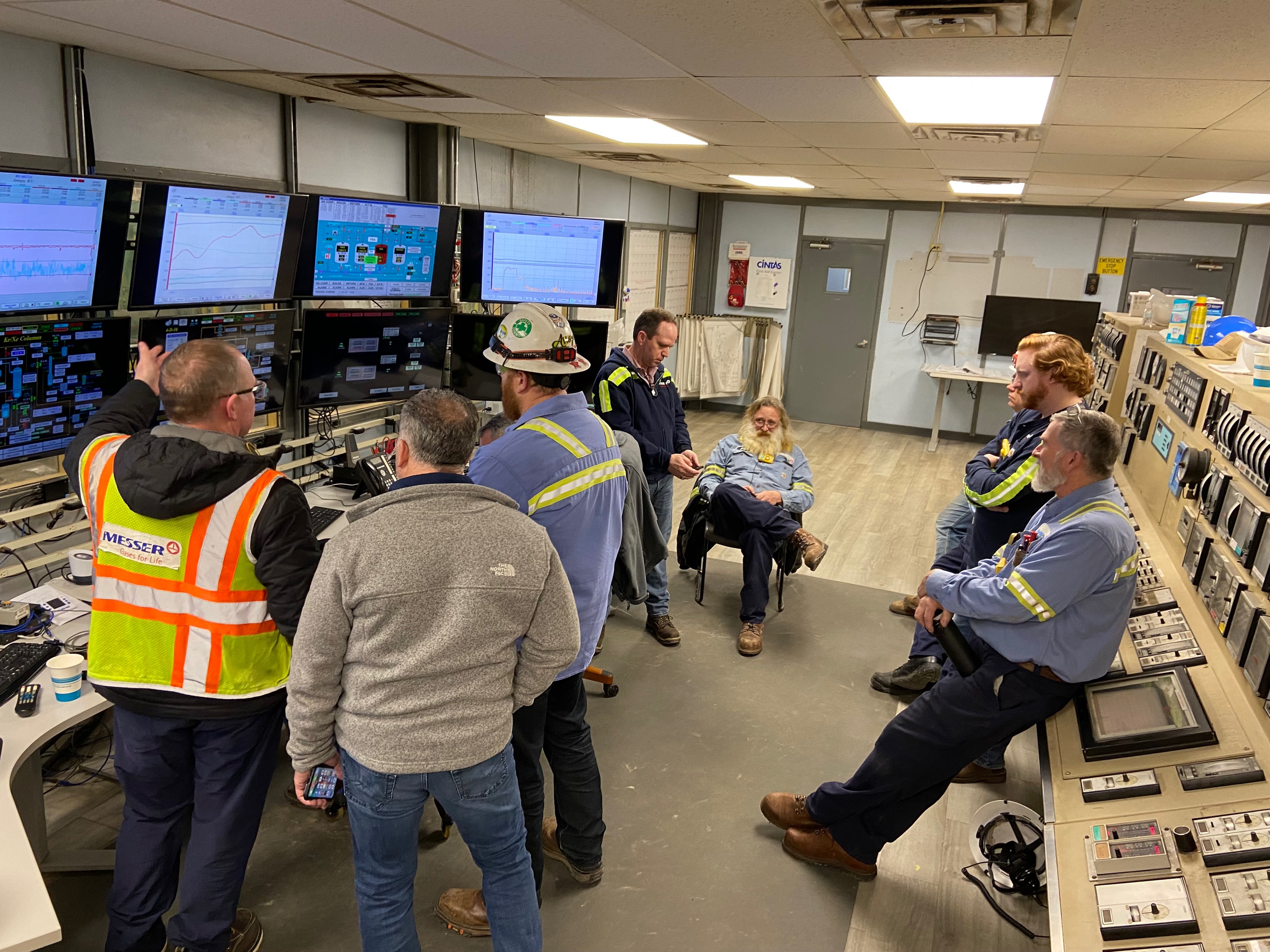
Led a structured RCA workshop using fishbone methodology to investigate temperature instability in a Kr/Xe distillation tower, producing prioritized corrective actions.

RCA Ishikawa Problem Solving Process

Market Opportunity Analysis

MBA research identifying Africa's automotive growth as a strategic hedge against EV-driven autocatalyst revenue declines, with ranked market shortlist and go-to-market recommendations.

MBA Market Research Strategic Analysis Global Business

A New Market Opportunity: Africa's Automotive Growth

In 2020, I researched and authored a market opportunity report for Johnson Matthey (as part of my MBA Global Business coursework) identifying Africa's automotive growth as a strategic hedge against expected autocatalyst revenue declines in established markets driven by EV adoption. The assessment evaluated rising population and incomes, low vehicle-ownership penetration, industrial policy, and local OEM/assembly activity across key countries (including Nigeria, Uganda, Ghana, Morocco, Egypt, and Tanzania) to prioritize near- and mid-term opportunities. The final deliverable provided a ranked market shortlist and practical go-to-market recommendations focused on partnership and early positioning to support future emissions solutions demand while electrification infrastructure remains uneven in many regions.

View Full Report

Opens PDF in new tab

Built and standardized an end-of-line (EOL) parameter collection system to reliably capture critical process and test values by unit/serial and shift, improving traceability and creating a clearer link between process conditions and downstream quality outcomes. The solution emphasized consistent parameter definitions, streamlined data entry and validation, and automated rollups for fast lookback analysis during quality events. Using structured data tables and automated reporting (e.g., Excel-based dashboards with pivot-style summaries and refreshable transforms), the tool enabled faster containment decisions, sharper root cause investigations, and more consistent cross-shift visibility into process health. For leadership, it reduced reliance on tribal knowledge and improved operational control by making performance drivers measurable, comparable, and reviewable.

Designed and deployed a changeover/startup sheet to standardize setup verification and early-run stabilization after product or configuration changes, reducing the variability that often drives startup scrap, rework, and schedule disruption. The sheet created a repeatable "green light" process that aligns operations, maintenance, and quality expectations by capturing critical checks (materials, settings, tooling, and CTQ verification) and clear acceptance criteria before normal production resumes. By applying standard work, visual controls, and shift-handoff integration, the approach improved consistency across teams and reduced the hidden factory created by inconsistent startups. This improved schedule attainment and predictability, tightened execution discipline, and made training and accountability easier because expectations were explicit and auditable.

Led a focused constraint-removal effort to eliminate cycle-time limitations by identifying bottlenecks and systematically addressing the highest-impact drivers of lost time and variability. The work combined time studies, station-to-station comparisons, and performance-loss review (OEE/performance loss logic) to isolate constraints, then implemented practical changes such as standardizing work content, removing non-value-added steps, tightening sequences and handoffs, and reducing recurring micro-delays that prevented consistent takt performance. The project used prioritization tools like Pareto ranking and workload balancing concepts (Yamazumi-style thinking) to ensure effort targeted throughput, not just activity. The result was a more stable production rhythm, improved capacity utilization, and better delivery reliability without requiring major capital investment.

Developed an advanced quality monitoring dashboard to shift quality management from reactive review to proactive detection by trending defects at a higher cadence with clearer categorization and ownership. The dashboard standardized defect taxonomy and organized signals by defect code/category, station/process step, and time window, enabling early identification of trend changes before they became major scrap spikes or customer risk. Built with automated reporting workflows (e.g., Excel/BI-style refreshable dashboards) and visual management tools (Pareto charts, trend indicators, and basic SPC-style thinking where appropriate), it created a consistent "single view" for daily/weekly quality review. For leadership, it improved prioritization and alignment, reduced the time to recognize and respond to emerging issues, and strengthened accountability by making the top drivers visible and trackable.

Improved battery testing efficiency by reducing avoidable delays and increasing repeatability in the test workflow while maintaining the rigor required for product confidence. The project focused on where time was being lost—waiting, retest loops, manual handling, inconsistent setup readiness—and implemented changes centered on process standardization, clearer test readiness criteria, simplified operator steps, and better visibility into failure modes and retest drivers. Using process mapping, time studies, standardized work, and automated rollups of test performance (throughput, retest trends, and failure categorization), the improvements increased effective station utilization and stabilized flow. This strengthened throughput capacity at a critical control point, improved schedule predictability, and reduced the operational drag of rework and repeated testing.

Led a structured defect reduction initiative targeting recurring quality losses that were driving scrap, rework, and operational instability, with an emphasis on sustainable corrective actions rather than short-term fixes. The approach combined defect stratification (where/when/how often), Pareto prioritization, and disciplined root cause analysis (5 Whys/fishbone-style thinking) to identify true drivers, then implemented countermeasures addressing both technical causes (process settings, tooling, materials) and execution causes (standard work clarity, training, and escalation triggers). Corrective actions were supported with control mechanisms—updated procedures, verification steps, and ongoing visibility—so regression could be detected early. The outcome was reduced cost of poor quality, improved yield protection, fewer production disruptions, and a stronger problem-solving culture grounded in data and repeatable controls.